


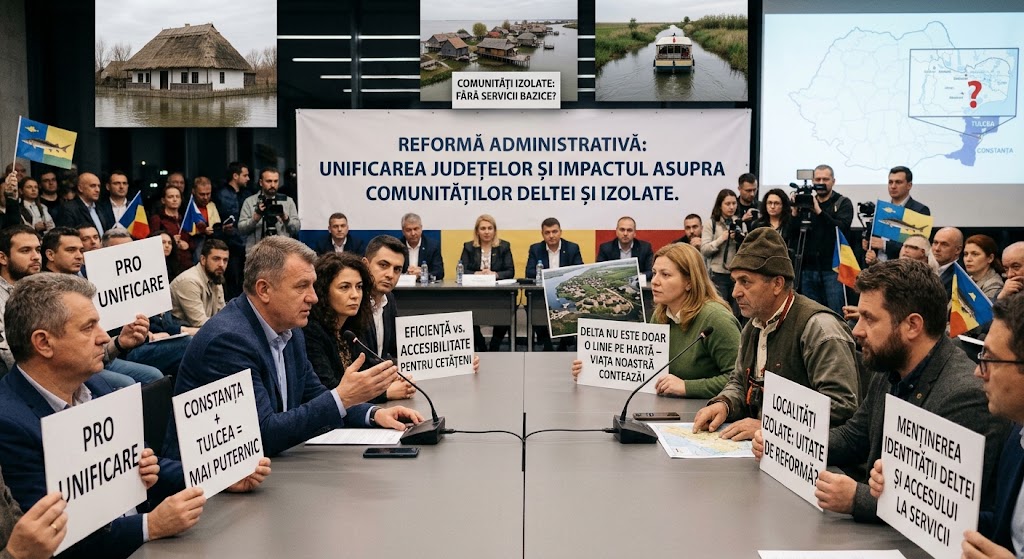
1. Impact on the inhabitants of the Danube Delta
The Danube Delta has a unique geographical regime in Romania, and applying standard administrative rules would create specific bottlenecks:
Increased distances and travel time. The villages of the Delta (such as Sfântu Gheorghe, Caraorman, Crișan or Periprava) depend almost exclusively on water transport. Moving decision-making centres to Constanța or merging neighbouring communes would force citizens to cover long distances by water and land to obtain permits, civil-status documents or social assistance.
High financial costs. Water transport is much more expensive and slower than road transport, and passenger services run on a limited schedule, especially in the cold season or when weather conditions are unfavourable.
Loss of local representation. Merging communes with a small population (many Delta localities have fewer than 1,500–3,000 inhabitants) would lead to the disappearance of local town halls and the concentration of decisions in a more distant centre, reducing the capacity for rapid response in emergencies (floods, frost, medical emergencies).
Risk to dedicated European funds. The Danube Delta currently benefits from a dedicated financial instrument (ITI Danube Delta), managed in close connection with the Tulcea authorities. Administrative dilution into a much larger county oriented towards coastal tourism or port activity could reduce the priority of Delta-specific projects.
2. Impact on the rest of the population of Tulcea County
Shifting the centre of gravity to Constanța. County institutions (Prefecture, County Council, health, finance or social assistance directorates) would be centralised in Constanța. For a resident of the north of the county (e.g. Măcin, Isaccea or Luncavița), a trip to Constanța and back exceeds 300–350 km, turning a simple administrative formality into a whole-day journey.
Downgrading small towns. All four towns in the county (Babadag, Măcin, Isaccea and Sulina) have fewer than 10,000 inhabitants. Changing their status to that of a commune would alter the local tax regime, could limit access to certain urban funding axes and would affect the status of public institutions in these localities (town hospitals, high schools, courts).
Competition for investment. In a joint Constanța–Tulcea county, the budget and administrative attention would tend to concentrate on the stronger and more populated economic pole (the Constanța metropolitan area and the Port), with the risk that road infrastructure and utilities in the Tulcea area remain secondary.
3. Possible benefits and mitigation measures
Reducing bureaucratic expenses. Merging administrative apparatuses could reduce the costs of salaries for local elected officials and senior civil servants, theoretically redirecting this money towards investment.
Compensatory solutions needed. So that the population is not penalised, such a reform should necessarily be accompanied by:
Complete digitalisation of public services, so that citizens do not have to travel for documents.
Maintaining local service points (one-stop shops or deputy mayors with delegated powers) in the isolated villages of the Delta.
Exempting the Danube Delta from the minimum population thresholds for merging communes, following the model of isolated mountain areas in other European states.
Applying the demographic thresholds discussed in the administrative reform bill would lead to the disappearance of almost 80% of the administrative-territorial units (ATUs) in Tulcea County, hitting the Danube Delta hardest, where all localities are below the threshold of 3,000 inhabitants, with the exception of the town of Sulina (which has 3,118 inhabitants but falls below the 10,000 threshold for towns).
1. Demographic radiography of the Danube Delta and the merger thresholds
According to the final data of the Population and Housing Census (RPL 2021) published by the Tulcea County Council, the county has 51 ATUs (1 municipality, 4 towns and 46 communes). In the variant where the threshold of 3,000 inhabitants for communes and 10,000 inhabitants for towns is imposed, 35 of the 46 communes and all 4 towns are targeted for merger or downgrading.
| Delta locality | Current status | Population (RPL 2021) | 1,500-inhabitant threshold (voluntary merger) | 3,000 / 10,000-inhabitant threshold (mandatory reform) |
|---|---|---|---|---|
| Pardina | Commune | 489 inhabitants | Below threshold (targeted) | Below threshold (targeted) |
| Ceatalchioi | Commune | 531 inhabitants | Below threshold (smallest in the county) | Below threshold (targeted) |
| C.A. Rosetti | Commune | 636 inhabitants | Below threshold (targeted) | Below threshold (targeted) |
| Sfântu Gheorghe | Commune | 639 inhabitants | Below threshold (targeted) | Below threshold (targeted) |
| Maliuc | Commune | 813 inhabitants | Below threshold (targeted) | Below threshold (targeted) |
| Crișan | Commune | 1,092 inhabitants | Below threshold (targeted) | Below threshold (targeted) |
| Chilia Veche | Commune | 1,728 inhabitants | Above threshold | Below threshold (targeted) |
| Mahmudia | Commune | 2,163 inhabitants | Above threshold | Below threshold (targeted) |
| Murighiol | Commune | 2,959 inhabitants | Above threshold | Below threshold (at the limit) |
| Sulina | Town | 3,118 inhabitants | Not applicable | Below threshold (downgrading to commune) |
2. Practical impact on the Delta communities
Merging these communes does not mean just a change on the map; it generates major bottlenecks in the daily life of the inhabitants:
The geographical paradox of merging. A commune such as Sfântu Gheorghe (639 inhabitants) or C.A. Rosetti (636 inhabitants) cannot easily be attached to a neighbouring commune. Between Sfântu Gheorghe and Murighiol or Sulina there are no public roads, and travel depends exclusively on water transport.
Costs and lost time for citizens. If the seat of the new town hall were moved tens of kilometres away by water, a resident of the isolated villages (Letea, Periprava, Caraorman, Mila 23) would pay considerable sums for transport and lose a whole day for a certificate, a death certificate or a social assistance file.
Vulnerability in emergencies. The town halls in the Delta are the first to intervene locally in the event of floods, ice bridges on the Danube, reed fires or medical emergencies. The disappearance of the local authority from the village leaves ageing communities without an immediate point of support.
The chain effect of merging with Constanța. If county decision-making were moved to Constanța, water infrastructure projects, subsidies for water transport and funds dedicated to the Danube Delta Biosphere Reserve would risk being managed by an administration focused on the coastal area and the Port of Constanța.
3. Reaction of local authorities and European exception models
The representatives of the county's mayors, through the voice of the president of the Association of Communes of Romania (ACoR) – Tulcea Branch, drew attention to the fact that the Danube Delta must be exempted from standard numerical criteria, because access is mainly by water and the administered areas are huge (for example, the commune of Sfântu Gheorghe has an area of over 605 km², larger than that of many municipalities).
In the European Union, administrative reforms that reduced the number of communes applied geographical exception clauses to avoid isolating the population:
The Nordic model (Finland and Sweden). Although these states massively merged communes for economic efficiency, they kept administrative units with very small populations (sometimes under 1,000 inhabitants) in archipelagos (e.g. the Åland Islands) and in Arctic regions, where large distances and water access make centralisation impossible.
The island and mountain model (Greece and France). In Greece (the Kallikratis reform), small islands received their own administrative status regardless of the number of inhabitants, precisely so as not to force citizens to cross the sea for basic services. In France, the "Mountain Law" and special statutes for protected wetlands provide derogations from standard demographic thresholds and require the maintenance of physical state service points (Maisons France Services) in isolated villages.
4. Recommended solutions for protecting the population
To avoid the depopulation and marginalisation of the Danube Delta in the event of a reform, specialists and local elected officials point to three essential directions:
Introducing the geographical criterion into the law. Establishing clear derogations for the localities of the Danube Delta Biosphere Reserve, where population density is the lowest in the country (under 23 inhabitants/km² at county level and much lower in the Delta).
Keeping the status of Tulcea County or creating a distinct administrative region for the Delta. Maintaining a decision-making centre close to the Danube communities, which directly manages the European funds dedicated to the area.
Administrative consortia instead of abolishing town halls. Neighbouring communes can share accounting, urban planning, public procurement or audit services (thus reducing personnel costs), but keep the mayor, the local council and the public relations desk in each isolated community.